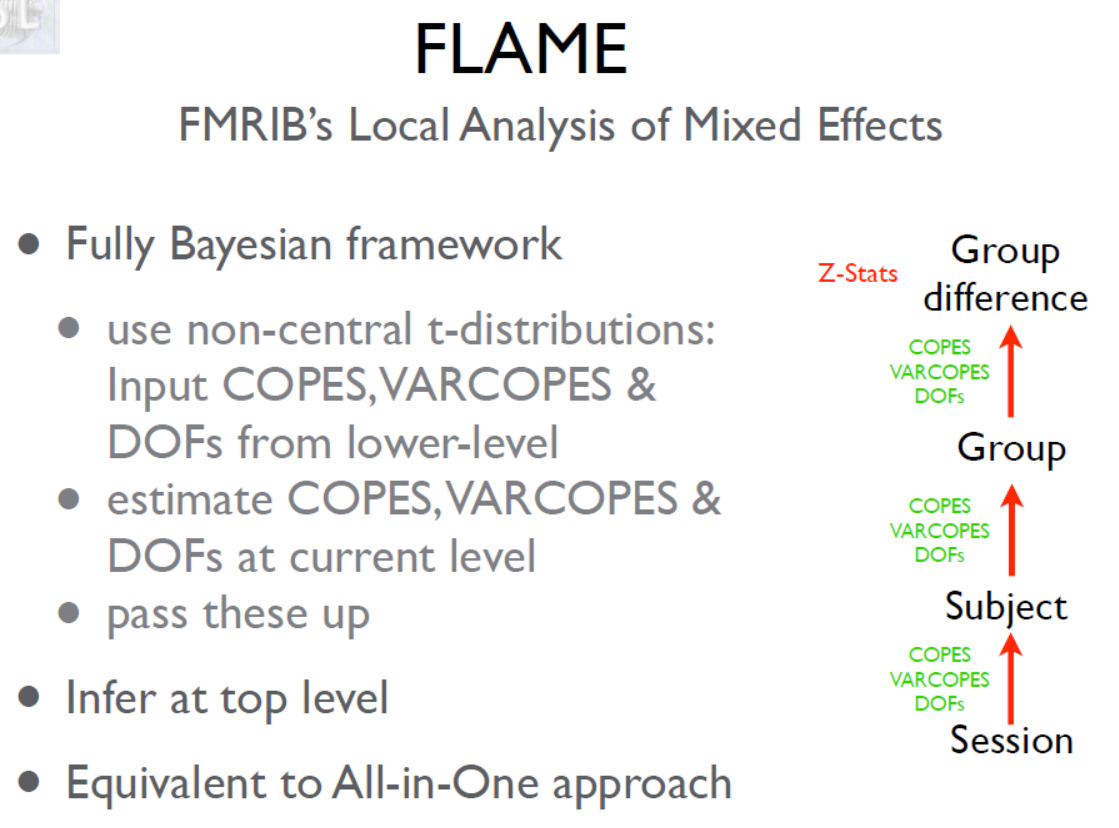
more: go to http://www.fmrib.ox.ac.uk/fslcourse
I enjoyed sharing my life experience with others. Hope this blog can be helpful. Let us have courage and be kind to one another every day. A short bio about me: I grew up in Shanghai, China and owned my Ph.D. in BME from University of Cincinnati in the end of 2013 and moved to Boston for a post-doc position at Boston Children's Hospital/Harvard Medical School. I used advanced imaging techniques (MEG, FMRI, EEG, DTI, etc) to study normal language and reading development in the past 10 years.
Saturday, October 8, 2011
Wednesday, October 5, 2011
My morning thoughts about FSL v.s. AFNI
About the source code,
FSL had several drawbacks. It did not give you error message and often overwrite the image, which can be problematic when you run a batch script. You might did something wrong but you will not know until you visualize your data. While AFNI does much better job for output message. The codes from AFNI is long and long. FSL codes are simple to read and digest.
FSL has some special functions like TBSS, fieldmap unwrapping, and dual-regression, etc. AFNI developers are slow to catch up in this aspect. They are too proud sometime. :-)
Thus, I use both. *_* I do like those linux based software. Fast and easy to run on the cluster machine. When you have tons of subjects, you have to use batch scripts.
FSL had several drawbacks. It did not give you error message and often overwrite the image, which can be problematic when you run a batch script. You might did something wrong but you will not know until you visualize your data. While AFNI does much better job for output message. The codes from AFNI is long and long. FSL codes are simple to read and digest.
FSL has some special functions like TBSS, fieldmap unwrapping, and dual-regression, etc. AFNI developers are slow to catch up in this aspect. They are too proud sometime. :-)
Thus, I use both. *_* I do like those linux based software. Fast and easy to run on the cluster machine. When you have tons of subjects, you have to use batch scripts.
Tuesday, October 4, 2011
Fieldmap issue.
https://www.jiscmail.ac.uk/cgi-bin/webadmin?A2=ind1008&L=FSL&P=R52486&1=FSL&9=A&J=on&X=571CB81652E87C1BC9&Y=yingying.wang%40cchmc.org&d=No+Match%3BMatch%3BMatches&z=4
Ben and I did not see Dr. Holland at his office and we went to talk to the Philips' technician (Dennis). He mentioned if the "CLEAR" option is on. The intensity of images will change. He is right. That might be the reason that the output of phase image scaled by 1000 from -pi to pi.
Try to make this work so it might benefit for the future study. USE fieldmap to reduce the frontal and temporal distortion.
https://www.jiscmail.ac.uk/cgi-bin/webadmin?A2=ind1109&L=FSL&P=R42533&1=FSL&9=A&J=on&X=571CB81652E87C1BC9&Y=yingying.wang%40cchmc.org&d=No+Match%3BMatch%3BMatches&z=4
Ben and I did not see Dr. Holland at his office and we went to talk to the Philips' technician (Dennis). He mentioned if the "CLEAR" option is on. The intensity of images will change. He is right. That might be the reason that the output of phase image scaled by 1000 from -pi to pi.
Try to make this work so it might benefit for the future study. USE fieldmap to reduce the frontal and temporal distortion.
https://www.jiscmail.ac.uk/cgi-bin/webadmin?A2=ind1109&L=FSL&P=R42533&1=FSL&9=A&J=on&X=571CB81652E87C1BC9&Y=yingying.wang%40cchmc.org&d=No+Match%3BMatch%3BMatches&z=4
Monday, October 3, 2011
Sunday, October 2, 2011
AFNI v.s. FSL
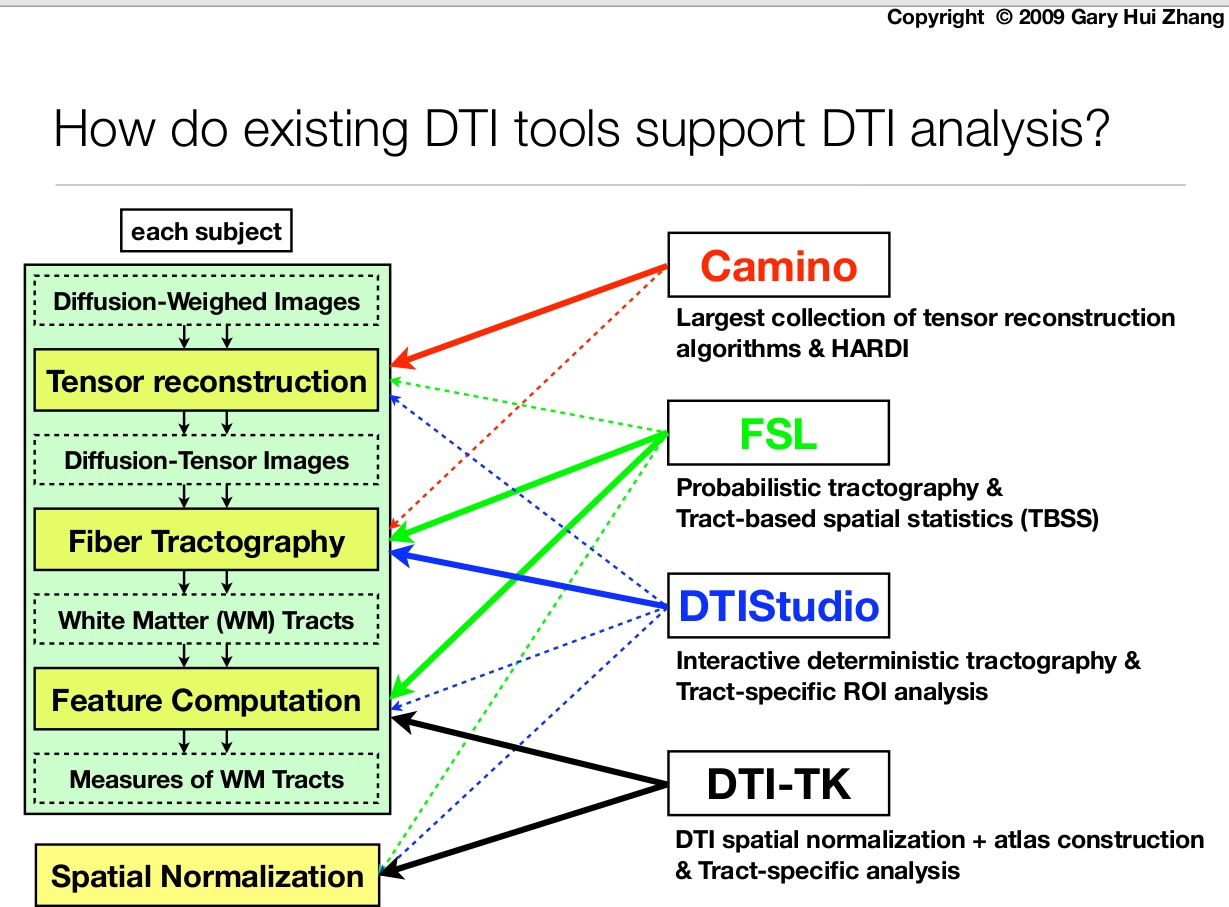
http://neurohub.ecs.soton.ac.uk/index.php/Software:AFNI
DTI program: dtifit (FSL) v.s. 3dDWItoDT (AFNI)
3dDWItoDT: over 2000 lines c code - nonlinear fitting - take care the low SNR problem, FA values are in [0 1] range.
dtifit: only 551 lines c code (easy to understand) - linear fitting (straightforward) but the package itself will not take care of the low SNR problem in the dataset and generate FA values more than 1 which is physically impossible.
The following message is from dti-tk website: http://dti-tk.sourceforge.net/pmwiki/pmwiki.php?n=Documentation.Diffusivity
http://www.dailymotion.com/video/xldrc5_a-video-tutorial-on-crossing-fibres_tech#rel-page-under-1
http://www.dailymotion.com/video/xk0hwc_non-invasive-histology-and-connectivity-mapping-of-the-brain_tech#rel-page-under-2
http://www.dailymotion.com/video/xjzxat_ismrm-2011-tutorial-group-analysis-atlases_tech#rel-page-under-3
DTI program: dtifit (FSL) v.s. 3dDWItoDT (AFNI)
3dDWItoDT: over 2000 lines c code - nonlinear fitting - take care the low SNR problem, FA values are in [0 1] range.
dtifit: only 551 lines c code (easy to understand) - linear fitting (straightforward) but the package itself will not take care of the low SNR problem in the dataset and generate FA values more than 1 which is physically impossible.
The following message is from dti-tk website: http://dti-tk.sourceforge.net/pmwiki/pmwiki.php?n=Documentation.Diffusivity
How to figure out the unit of diffusivity in a DTI volume?
If, for diffusion-weighting, b-value of 800 s.mm-2 is used during the acquisition, and you input the number 800 as the b-value to your tensor reconstruction program, then the output DTI volume will have the unit of mm2.s-1.Alternatively, you can compute the trace map of your DTI volumes. If you find that the trace values for CSF are close to 10-2, then most likely it is in the unit of mm2.s-1.
- For AFNI users: 3dDWtoDT in AFNI does NOT factor b-value into the tensor estimation (Read more here). As a result, the program essentially always assume the b-value to be equal to 1. If the actual b-value is 1,000 s.mm2, then the equivalent unit of diffusivity used by 3dDWItoDT is the same as DTI-TK. If the actual b-value is 800 s.mm2, then the equivalent unit of diffusivity is 1/800 mm2.s-1 instead. The multiplication factor should then be 1.25.
- For Camino users: In general, it depends on how the scheme file is created. If the scheme file conforms to the default unit of Camino, the diffusivity unit should be m2.s-1.
- For FSL users: If the correct b-value is used for the corresponding entries in the bval file, then the diffusivity unit should be mm2.s-1.
http://www.dailymotion.com/video/xldrc5_a-video-tutorial-on-crossing-fibres_tech#rel-page-under-1
http://www.dailymotion.com/video/xk0hwc_non-invasive-histology-and-connectivity-mapping-of-the-brain_tech#rel-page-under-2
http://www.dailymotion.com/video/xjzxat_ismrm-2011-tutorial-group-analysis-atlases_tech#rel-page-under-3
FSL source code compiling under Debian.
FSL Feeds not all tasks are passed.
I ended up installing Debian package by the NeuroDebian Team.
http://neuro.debian.net/pkgs.html
http://neuro.debian.net/pkgs/fsl.html
YEAH!
yingying@yingying-debian:~/opt/fsl_feeds$ time ./RUN all
FSL Evaluation and Example Data Suite v4.1.8
start time = Sun Oct 2 00:55:22 EDT 2011
hostname = yingying-debian
os = Linux yingying-debian 2.6.32-5-amd64 #1 SMP Fri Sep 9 20:23:16 UTC 2011 x86_64 GNU/Linux
/bin/rm -rf /home/yingying/opt/fsl_feeds/results ; mkdir /home/yingying/opt/fsl_feeds/results
Starting PRELUDE & FUGUE at Sun Oct 2 00:55:22 EDT 2011
% error = 0.0
% error = 0.0
Starting SUSAN at Sun Oct 2 00:55:25 EDT 2011
% error = 0.03
Starting SIENAX (including testing BET and FLIRT and FAST) at Sun Oct 2 00:58:37 EDT 2011
checking error on BET:
% error = 0.0
checking error on FLIRT:
% error = 0.0
checking error on FAST:
checking error on single-image binary segmentation:
% error = 0.37
checking error on partial volume images:
% error = 0.28
% error = 0.41
% error = 0.29
checking error on SIENAX volume outputs:
% error = 0.18
% error = 0.11
% error = 0.49
% error = 0.02
% error = 0.51
Starting BET2 at Sun Oct 2 01:19:05 EDT 2011
checking error on T1 brain extraction:
% error = 0.0
checking error on skull and scalp surfaces:
% error = 0.02
% error = 0.03
% error = 0.14
Starting FEAT at Sun Oct 2 01:33:20 EDT 2011
checking error on filtered functional data:
% error = 0.08
checking error on raw Z stat images:
% error = 0.28
% error = 0.17
% error = 0.23
checking error on thresholded Z stat images:
% error = 0.37
% error = 0.3
% error = 0.32
checking error on registration images:
% error = 0.0
% error = 0.0
checking error on position of largest cluster of Talairached zfstat1:
% error = 0.0
% error = 0.0
% error = 0.0
% error = 0.05
% error = 0.1
% error = 0.08
Starting MELODIC at Sun Oct 2 01:45:01 EDT 2011
% error = 0.66
Starting FIRST at Sun Oct 2 01:55:47 EDT 2011
% error = 0.67
Starting FDT (bedpost) at Sun Oct 2 02:07:29 EDT 2011
checking error on bedpost output:
% error = 0.25
% error = 0.01
% error = 0.31
% error = 0.21
% error = 0.07
% error = 0.3
% error = 0.21
Starting FNIRT at Sun Oct 2 02:16:58 EDT 2011
% error = 0.0
All tests passed
end time = Sun Oct 2 02:16:59 EDT 2011
real 81m37.291s
user 43m16.954s
sys 0m57.920s
Worked!
I ended up installing Debian package by the NeuroDebian Team.
http://neuro.debian.net/pkgs.html
http://neuro.debian.net/pkgs/fsl.html
YEAH!
yingying@yingying-debian:~/opt/fsl_feeds$ time ./RUN all
FSL Evaluation and Example Data Suite v4.1.8
start time = Sun Oct 2 00:55:22 EDT 2011
hostname = yingying-debian
os = Linux yingying-debian 2.6.32-5-amd64 #1 SMP Fri Sep 9 20:23:16 UTC 2011 x86_64 GNU/Linux
/bin/rm -rf /home/yingying/opt/fsl_feeds/results ; mkdir /home/yingying/opt/fsl_feeds/results
Starting PRELUDE & FUGUE at Sun Oct 2 00:55:22 EDT 2011
% error = 0.0
% error = 0.0
Starting SUSAN at Sun Oct 2 00:55:25 EDT 2011
% error = 0.03
Starting SIENAX (including testing BET and FLIRT and FAST) at Sun Oct 2 00:58:37 EDT 2011
checking error on BET:
% error = 0.0
checking error on FLIRT:
% error = 0.0
checking error on FAST:
checking error on single-image binary segmentation:
% error = 0.37
checking error on partial volume images:
% error = 0.28
% error = 0.41
% error = 0.29
checking error on SIENAX volume outputs:
% error = 0.18
% error = 0.11
% error = 0.49
% error = 0.02
% error = 0.51
Starting BET2 at Sun Oct 2 01:19:05 EDT 2011
checking error on T1 brain extraction:
% error = 0.0
checking error on skull and scalp surfaces:
% error = 0.02
% error = 0.03
% error = 0.14
Starting FEAT at Sun Oct 2 01:33:20 EDT 2011
checking error on filtered functional data:
% error = 0.08
checking error on raw Z stat images:
% error = 0.28
% error = 0.17
% error = 0.23
checking error on thresholded Z stat images:
% error = 0.37
% error = 0.3
% error = 0.32
checking error on registration images:
% error = 0.0
% error = 0.0
checking error on position of largest cluster of Talairached zfstat1:
% error = 0.0
% error = 0.0
% error = 0.0
% error = 0.05
% error = 0.1
% error = 0.08
Starting MELODIC at Sun Oct 2 01:45:01 EDT 2011
% error = 0.66
Starting FIRST at Sun Oct 2 01:55:47 EDT 2011
% error = 0.67
Starting FDT (bedpost) at Sun Oct 2 02:07:29 EDT 2011
checking error on bedpost output:
% error = 0.25
% error = 0.01
% error = 0.31
% error = 0.21
% error = 0.07
% error = 0.3
% error = 0.21
Starting FNIRT at Sun Oct 2 02:16:58 EDT 2011
% error = 0.0
All tests passed
end time = Sun Oct 2 02:16:59 EDT 2011
real 81m37.291s
user 43m16.954s
sys 0m57.920s
Worked!
Subscribe to:
Posts (Atom)
